inally, the warring sides settled on a $135 million budget,
with wiggle room for an additional $5 million. Anything over that would
come directly out of Bruckheimer’s and Bay’s pockets. Like most of the
cast, Affleck worked for a fraction of his $12 million fee, earning
$250,000 with a promise of a far bigger paycheck if the film succeeds.
“They didn’t have any money,” Affleck says. inally, the warring sides settled on a $135 million budget,
with wiggle room for an additional $5 million. Anything over that would
come directly out of Bruckheimer’s and Bay’s pockets. Like most of the
cast, Affleck worked for a fraction of his $12 million fee, earning
$250,000 with a promise of a far bigger paycheck if the film succeeds.
“They didn’t have any money,” Affleck says.
It wasn’t just a lack of cash that made casting the film
difficult. Bay selected relative unknowns Kate Beckinsale and Josh
Hartnett to star as nurse Evelyn Johnson and flier Danny Walker. Weinstein
wanted Beckinsale first to film Miramax’s “Serendipity” and held the
rights to Hartnett’s next movie. Unless he got Beckinsale, Weinstein
would block Hartnett’s working on “Pearl Harbor,” the filmmakers and
Disney say. (Miramax disputes this, saying it accommodated “Pearl
Harbor.”) But Disney wouldn’t budge and Weinstein had to wait.
With so little money allocated on talent, Bay and Bruckheimer
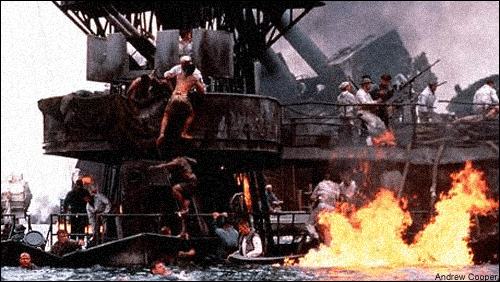
had plenty to put on- screen when filming began in April of last year. The
intricate battle sequences involved blowing up 17 ships, vintage planes
screaming over panicked soldiers’ heads and, in one chaotic scene on
Battleship Row, 350 bombs exploding in seven seconds. “We were very
lucky,” studio chief Schneider says. “Nothing went wrong.” Even when
a stunt pilot totaled his plane, his main injury was a broken pinkie.
A premium was placed on authenticity; Affleck wears a Hawaiian shirt
copied from 1930s fabric, and just as real Pearl Harbor medical personnel
used soda bottles in emergency blood transfusions, so do the film’s
nurses. Working with the cooperation of the Navy, the movie used a real
U.S. aircraft carrier to re-create Doolittle’s daring Tokyo attack.
Historical consultants offered so much advice that Bay hired two
additional screenwriters to incorporate the suggestions and polish
Wallace’s dialogue.
Much of the invasion that serves as the film’s centerpiece was
re-created on computers at George Lucas’s Industrial Light + Magic,
which added everything from digital water to a squadron of digital planes
and a fleet of doomed ships in between. The keeling over of the USS
Oklahoma was staged by filming a 150-foot portion of the hull rotating in
the huge water tank used for “Titanic.” The rest of the ship,
including sailors perishing in fireballs, was added by computer animators.
The budget cuts are most visible in a snippet from the Battle of Britain
and the aftermath of Doolittle’s raid. “Still, $135 million for this
movie is a f—king steal,” Bay says.
Bay himself paid a high price for “Pearl Harbor.” Having deferred
his salary, the director borrowed money from Disney before the shoot,
placing the funds in a Beverly Hills Merrill Lynch account. Bay says a
young trader began churning his account, making up to 1,000 trades
monthly, losing as much as $200,000 a day. By the time “Pearl Harbor”
was almost finished, so, too, was Bay’s account: his $3 million
portfolio was wiped out. “You couldn’t trade this badly if you wanted
to,” says the shell-shocked director, who is considering suing Merrill
Lynch, which declined to comment.
|